genocideprevention.eu
  • Home
  • About Us
  • Events
    • Past events
  • Projects
    • Closed projects
  • Publications
    • Earlier publications
  • Alliance for Dialogue
    • Institutionalization
    • Pan-European initiative
  • News
  • E-Youth Library
  • Contact
Featured

Key UN sessions for R2P in 2023

The General Assembly held a plenary meeting on the “Responsibility to Protect (R2P) and the prevention of genocide, war crimes, ethnic cleansing and crimes against humanity” on 26 and 30 June as part of the formal agenda of its 77th session. As states gathered in the General Assembly to discuss challenges and best practices for the implementation of R2P, this year’s debate took place amidst the backdrop of alarming global levels of violence, persecution and conflict, including the outbreak of new conflicts in countries like Sudan with a recent history of atrocities

  • Click here to read the summary on this year's UN General Assembly Plenary Meeting on the Responsibility to Protect.

The 53rd regular session of the UN Human Rights Council (HRC) was held in Geneva between 19 June and 14 July 2023. As the primary international human rights body, the HRC has the capacity to prevent and respond to mass atrocity crimes, as systematic violations and abuses of human rights can be an indicator of potential genocide, war crimes, crimes against humanity or ethnic cleansing. 
                                                     
  • Click here to read the summary which highlights major outcomes and relevant dialogues as they relate to the Responsibility to Protect (R2P), atrocity prevention and populations at risk of atrocity crimes.
  • Watch here the interactive dialogue with the Special Adviser to the Secretary-General on the Prevention of Genocide, Alice Wairimu Nderitu, conducted at the 53rd Regular Session of Human Rights Council.

Source : Global Centre for the Responsibility to Protect
26 July 2023
Featured

Latest addition of the E-Youth Library

Atrocity alert No. 356: Sudan, Democratic Republic of the Congo and Syria,
Publication of the Global Centre for the Responsibility to Protect. Click here.

PUBLICATION - Drawing on the crisis in Cameroon as an example, this article discusses how practitioners—especially policy makers and non-governmental advocates—can use the Simon-Skjodt Center’s Tools for Atrocity Prevention resource to inform and strengthen policy responses to specific cases. Click here.

VIDEO 


PUBLICATION - Shirin Anlen and Raquel Vazquez Llorente highlight the potential of using AI tools to support human rights advocacy and social critique, without neglecting appropriate caution and ethical considerations. Click here. 

PODCAST - Engaging with the powerful
Click here to access this episode from the Centre of Humanitarian Dialogue with Haile Menkerios.

PUBLICATION - Kristina Hook and Ernesto Verdeja examine how social media misinformation (SMM) can worsen political instability and legitimize mass atrocities. They propose several recommendations for the instability and atrocity prevention community. Click here.


25 July 2023
Featured

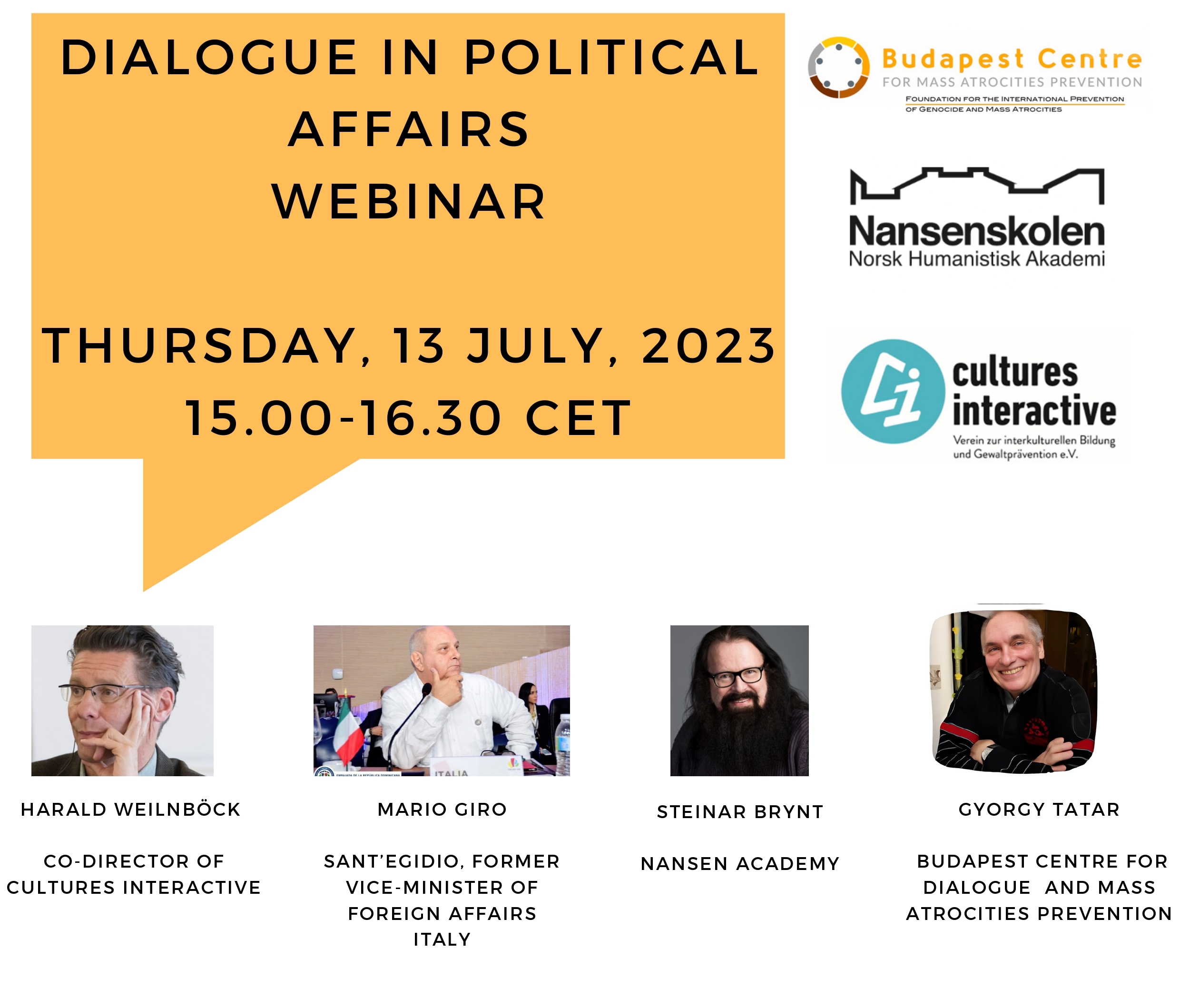
Dialogue in Political Affairs webinar - Watch here


1ReminderDialogue in Political Affairs WEBINAR TUESDAY 13 JULY 2023 page 0001 1


In his introductory intervention Mr Harald Weilnböck (Cultures Interactive, 6:58 - 25:05) argues for the need to replace the concept of extremism and term of prevention in favour of dialogue, education and skill building. He explained while dialogue builds bridges and connections, extremism and prevention tend inspire a habitus of intercepting, fighting and countering, while looking for dangers and enemies, hence tends to break off potential bridges and connections. It often even generates discrimination. Mr. Weilnböck points out we need a change of paradigm in order to better support democracy. Furthermore, Mr. Weilnböck shortly argued for the alternative concept of Group focused enmity/hatred, and Authorianism used in Germany and shared some good practice standards. 

Mr. Mario Giro  (29:04 - 45:45) calling himself as non-institutional mediator gave an overview of his peace making activities. He explained through concrete cases the difficulties and weaknesses of  track 1.0 and track 2.0 diplomacy, argued for the combination of the state-guaranteed diplomacy and the flexible peace initiatives of the civil societies and spoke about the dilemmas of track 1.5 diplomacy where he was involved through Sant’Egidio Community. By referring to various conflict situations, he questioned the concept of ''war as a solution for conflicts'' and shared some lessons learned during his activities whilst highlighted the differences between peace agreeements and societal reconciliation. 

Mr. Steinar Brynt (48:45 - 1:13:10) spoke about the dilemmas and similarities of the war of thenineties in Western Balkans and the war between Russia and Ukraine since 2014. He pointed to the fact that through the intensification of the conflict situation between the two countries dialogue became increasingly difficult and ultimately stopped. He touched upon issues of nation states, revival of traditionalism, possibilities and limitations of dialogue, the relationship building methodology, why we do not embrace dialogue, can dialogue be counterproductive under conflict and the need for finding a common language with those representing other concepts. 

Mr. Gyorgy Tatar (1:35:05 - 1:48:35) highlighted the background and main objectives of the draft Statement circulated prior to the webinar. He initiated the establishment of an international Alliance of Dialogue for institutionalization of the tool of dialogue in international and national decision- making processes and inclusion of dialogue-related issues in the national educational curricula as well as the enhancement of collaboration of dialogue practitioners. Mr. Tatar invited the participants to give feedback on the initiative in the next few weeks.  
06 July 2023
Featured

Latest addition of the E-Youth Library

Atrocity alert No. 354: Children and Armed Conflict, and Mali
Publication of the Global Centre for the Responsibility to Protect. Click
. 
06 July 2023
Featured

Stop Hatred by Dialogue!

Prominent practitioners shared experiences on the significance and methodologies of dialogue as well as the challenges of dialogue facilitation in the Middle East, Western Balkans, Cyprus, and Germany.

The examples highlighted dialogue as an effective tool for preventing extremism and transforming hostile and complex conflict situations into sustainable peaceful processes.

Check out the programme

26 January 2023
Featured

Contestation of RtoP in the Post-Liberal Era

Dialogue Forum. Series of Interviews with Experts

This series of interviews aims at shedding a light on the contemporary challenges to implement the Responsibility to Protect.
By that we continue our effort to provide space for scholars and practitioners to express their views on even controversial issues which impede the translation of the RtoP into action. Ultimately here, our goal is to provide space for the views of scholars and practitioners on the role of dialogue in bridging the conflict between universal human rights values and cultural relativism from the perspective of mass atrocity prevention.
 
The Budapest Centre for Dialogue and Mass Atrocities Prevention shares herewith an interview with researcher Dr. Thomas Peak on the contemporary challenges in mobilizing actors of the Global South to implement the Responsibility to Protect.
This interview was made by Dr. Gyorgy Tatar, President of BCDMAP, and Dr. Gary Uzonyi, the senior faculty research fellow of BCDMAP.


In this second episode of the series of interviews, we had the opportunity to exchange with Dr. Karen Smith, the UN Special Adviser on the Responsibility to Protect between 2019-2021
This interview was made by Dr. Gyorgy Tatar, President of BCDMAP, and Dr. Gary Uzonyi, the senior faculty research fellow of BCDMAP.

We elaborate on topics such as; the influence of the changing global world order on the implementation of RtoP, contemporary challenges of RtoP,
the role of dialogue in advancing consensus on RtoP between Global North and South and the skepticism of the Global South on the activities of the International Criminal Court.

20 April 2023
Featured

EU Day Against Impunity : 23rd May 2023

Since 2016, the EU Day Against Impunity (EUDAI) is celebrated on the 23rd of May under the auspices of the Presidency of the Council of the EU in cooperation with the European Commission, the Genocide Network and the European Union Agency for Criminal Justice Cooperation (Eurojust).

This event aims at raising awareness of impunity related to core international crimes, which encompass the crime of genocide, crimes against humanity and war crimes. Furthermore, it is intended to promote national investigations and prosecutions, to formally recognise the common efforts of the EU Member States and the European Union in enforcing international criminal law, to address the position and participation of victims in criminal proceedings for these crimes, and to reinvigorate Europe-wide commitment to the continuing fight against impunity for these crimes.

Watch this year's EU Day Against Impunity by clicking below. 
 for the Adoption of the Convention on International Cooperation in the Investigation and Prosecution of Genocide, Crimes Against Humanity, War Crimes and other International Crimes. The aim of the Diplomatic Conference is to conduct formal negotiations that will result in the adoption of a new procedural multilateral treaty on mutual legal assistance and extradition in order to facilitate better practical cooperation between States investigating and prosecuting core international crimes.The draft Convention also foresees that State parties should establish extraterritorial jurisdiction over these types of crimes when the alleged offender is present on the State party’s territory. 

Get more insights now : here and there.
25 May 2023
Featured

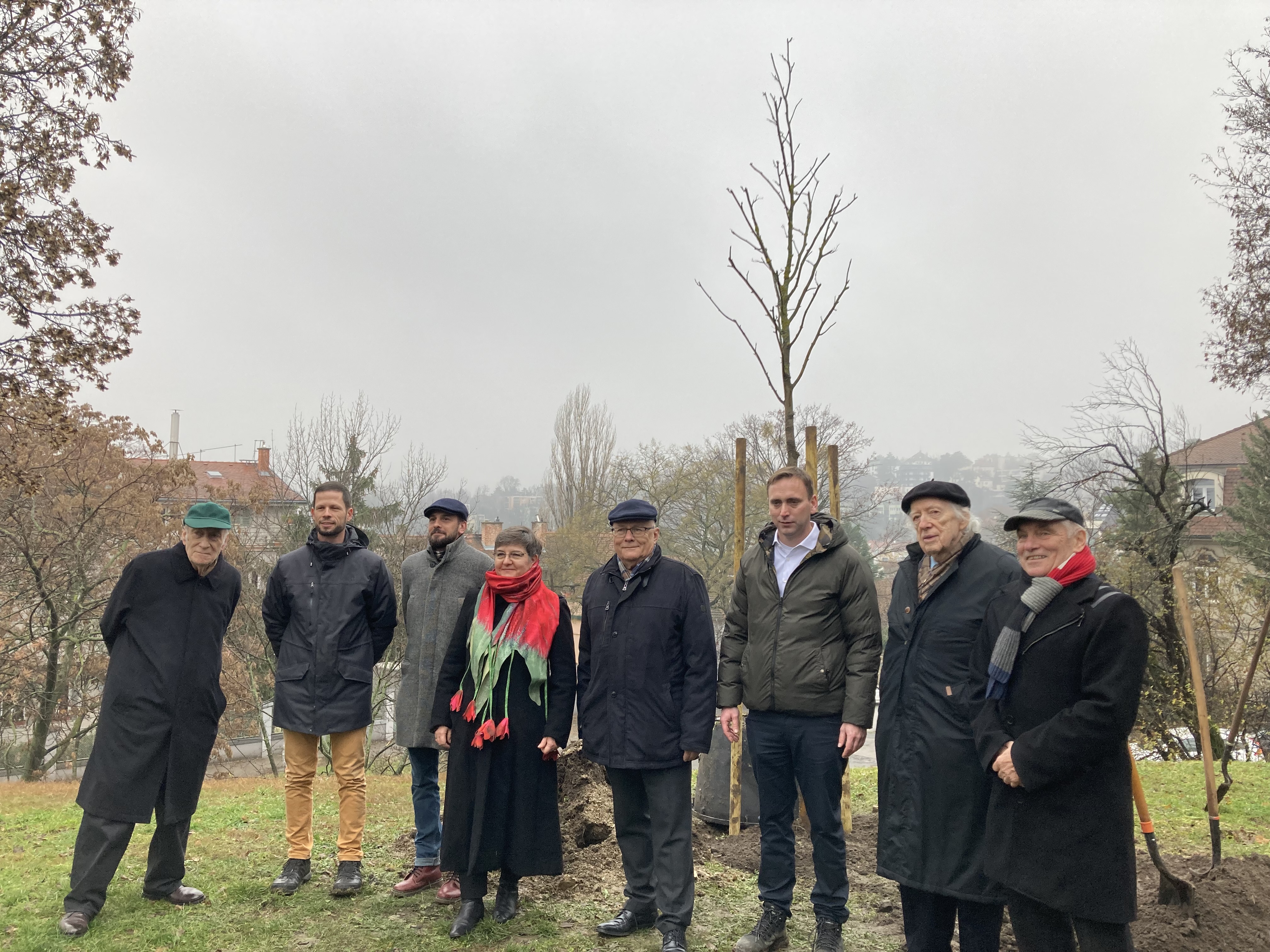
Third Dialogue Tree in Bibo park, Budapest 2nd district

Social peace requires social dialogue

On 16 December 2022, the Budapest Center for Dialogue and Mass Atrocities Prevention, in cooperation with the Second District Municipality of Budapest, planted the third Dialogue Tree in István Bibó Park.
Bibo Parbeszedfa
18 December 2022
Read more: Third Dialogue Tree in Bibo...
  • 1
  • 2
  • 3
  • 4
  • 5
  • 6
  • 7
  • 8
  • 9
  • 10
donate_button_copy2.png

Partner organizations

  • UN Office for Genocide Prevention and the R2P
  • United Nations Human Rights Council
  • International Criminal Court (ICC)
  • Global Action Against Mass Atrocity Crimes
  • Global Centre for R2P
  • European Network for investigation and prosecution of genocide, crimes against humanity and war crimes (‘Genocide Network’)
  • United States Holocaust Memorial Museum
  • Genocide Watch
  • Montreal Institute for Genocide and Human Rights Studies
  • Asia-Pacific Centre for the Responsibility to Protect
  • Canadian Centre for the Responsibility to Protect (CCR2P)
  • Radicalization Awareness Network
  • European Peacebuilding Liaison Office (EPLO)
  • European Institute of Peace
© 2020-2026 Budapest Centre for Mass Atrocities Prevention
facebook_copy3.png youtube_copy4.png instagram_copy2.png tiktok_copy1.png
  • Home
  • About Us
  • Events
    • Past events
  • Projects
    • Closed projects
  • Publications
    • Earlier publications
  • Alliance for Dialogue
    • Institutionalization
    • Pan-European initiative
  • News
  • E-Youth Library
  • Contact