The Budapest Centre calls your attention to the newly published EPLO statement on The European Peace Facility: Minimising Significant Risks in Implementation.
Category: Publications">
PublicationsPublished: 07 September 2021">
The Budapest Centre is proud to present the new piece of its Artificial Intelligence series On the Use of Artificial Intelligence in the framework of the Syrian War.
This paper innovatively provides a compilation of AI weapons and tools applied by a multitude of actors during the conflict and concludes by stating how their employment jeopardizes human rights, thereby stressing the necessity of a universal regulation on the development and misuse of AI - from the perspective of mass atrocities.
We wish to point out that Artificial Intelligence plays an increasing role in conflict scenarios: At the same time that it has become a tool for human rights violations, it also holds the potential to play a positive role in genocide prevention, victims’ support, and reconstruction.
Category: Publications">
PublicationsPublished: 16 July 2021">
The Budapest Centre is proud to share its latest policy paper Misuse of Artificial Intelligence: Occupied Palestinian Territories. Case study.
As a new piece of the Artificial Intelligence series of the Budapest Centre for Mass Atrocities Prevention, this paper offers an insight on how the Israeli authorities apply tools of Artificial Intelligence (AI) in the Occupied Palestinian Territories by pointing to the significance and risks of using AI during conflict—without wishing to provide an exhaustive and detailed list of challenges and their respective international activities. Our aim is to further engender the International Community’s political will to address these threats from the perspective of conflict escalation and mass atrocity crimes prevention.
The authors and the Budapest Centre hope that this research will prove useful in particular for young readers who wish to learn more about the ongoing conflict in the Occupied Palestinian Territories and the role AI plays in mass atrocity crimes.
Category: Publications">
PublicationsPublished: 15 June 2021">
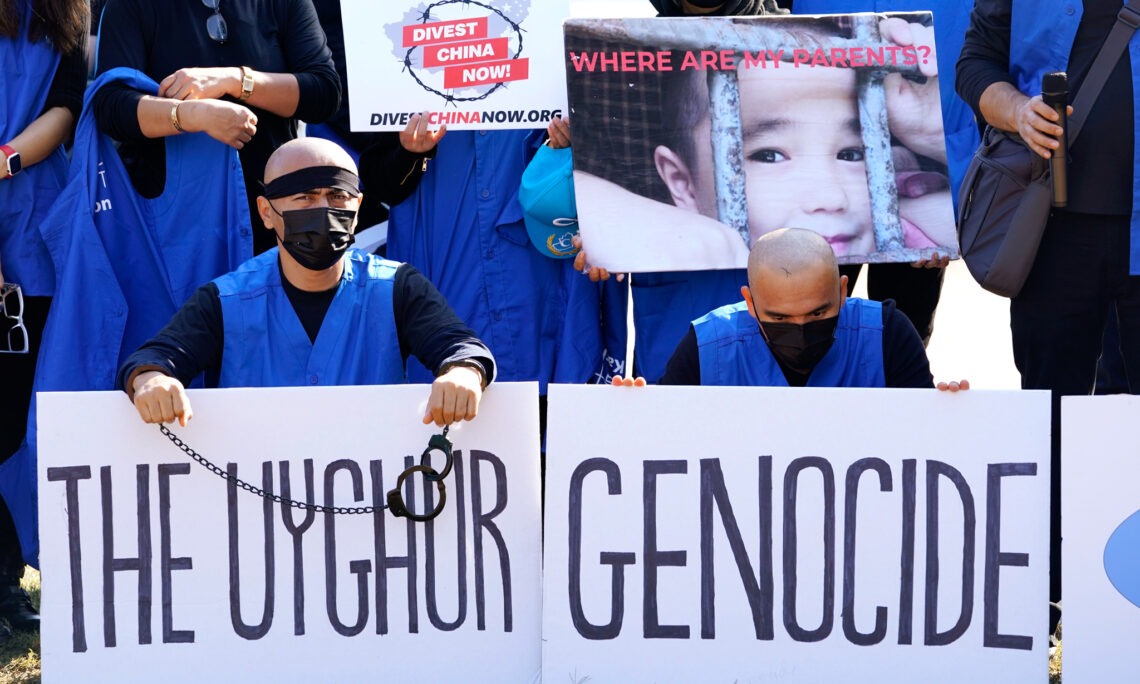
The Budapest Centre for Mass Atrocities Prevention invites you to check out this interview to Dr. Gyorgy Tatar, the Director of the Centre and Chair of the Board of Trustees, on the Uyghur Genocide - following the last report published by the Newlines Institute for Strategy and Policy.
The interviewer is Laura Pistarini Teixeira Nunes - an intern both at the Budapest Centre and the Institute for Cultural Relations Policy - who has written her master's dissertation on the persecution of Uyghurs in China.
You can find both the interview and her short article in the following link:
We invite you to read the essay "What is at stake in handling the case of the Uyghurs?"prepared by the Director of the Centre, Dr. Gyorgy Tatar. The Budapest Centre for Mass Atrocities Prevention thereby urges the International Community to take all appropriate measures discussed in the document to tackle the Uyghur Genocide and prevent further escalation.
The Budapest Centre for Mass Atrocities Prevention strongly encourages its visitors to take a look at the following high-level event that took place on the 12th of May. The event comprised both State Representatives, members of NGOs and civil society organizations, academics and personal testimonies.
The international community has been brought together to take a stand in the Uyghur Question on this occasion, and some of the propositions and requests consisted of: a tougher response on the part of the UN over China in order to take steps to solve the issue, including a more present stance by the Human Rights Council, the Office of the United Nations High Commissioner, and the General Assembly; the imposition of an international and independent investigative mechanism in order to examine and monitor human rights violations in the region and hold perpetrators accountable; the end of importation from Xinjiang to avoid financing abuses.
The position of the speakers can be efficiently summarized by the words of Agnès Callamard, current Secretary-General of Amnesty International, who stressed that silence regarding the situation in the Xinjiang Uyghur Autonomous Region “tarnishes the human rights system, weakens the UN overall and betrays our duty to the people of China”.