The Budapest Centre is proud to present the new piece of its Artificial Intelligence series On the Use of Artificial Intelligence in the framework of the Syrian War.
This paper innovatively provides a compilation of AI weapons and tools applied by a multitude of actors during the conflict and concludes by stating how their employment jeopardizes human rights, thereby stressing the necessity of a universal regulation on the development and misuse of AI - from the perspective of mass atrocities.
We wish to point out that Artificial Intelligence plays an increasing role in conflict scenarios: At the same time that it has become a tool for human rights violations, it also holds the potential to play a positive role in genocide prevention, victims’ support, and reconstruction.
The Budapest Centre is proud to share its latest policy paper Misuse of Artificial Intelligence: Occupied Palestinian Territories. Case study.
As a new piece of the Artificial Intelligence series of the Budapest Centre for Mass Atrocities Prevention, this paper offers an insight on how the Israeli authorities apply tools of Artificial Intelligence (AI) in the Occupied Palestinian Territories by pointing to the significance and risks of using AI during conflict—without wishing to provide an exhaustive and detailed list of challenges and their respective international activities. Our aim is to further engender the International Community’s political will to address these threats from the perspective of conflict escalation and mass atrocity crimes prevention.
The authors and the Budapest Centre hope that this research will prove useful in particular for young readers who wish to learn more about the ongoing conflict in the Occupied Palestinian Territories and the role AI plays in mass atrocity crimes.
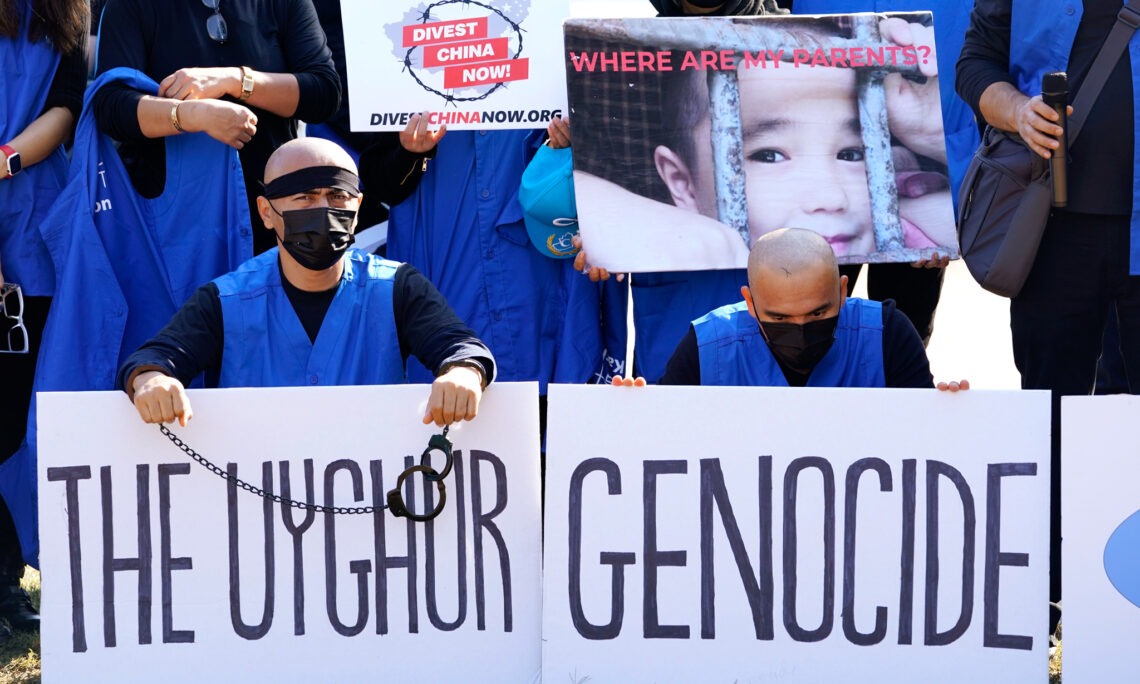
The Budapest Centre for Mass Atrocities Prevention invites you to check out this interview to Dr. Gyorgy Tatar, the Director of the Centre and Chair of the Board of Trustees, on the Uyghur Genocide - following the last report published by the Newlines Institute for Strategy and Policy.
The interviewer is Laura Pistarini Teixeira Nunes - an intern both at the Budapest Centre and the Institute for Cultural Relations Policy - who has written her master's dissertation on the persecution of Uyghurs in China.
You can find both the interview and her short article in the following link:
We invite you to read the essay "What is at stake in handling the case of the Uyghurs?"prepared by the Director of the Centre, Dr. Gyorgy Tatar. The Budapest Centre for Mass Atrocities Prevention thereby urges the International Community to take all appropriate measures discussed in the document to tackle the Uyghur Genocide and prevent further escalation.
The Budapest Centre for Mass Atrocities Prevention strongly encourages its visitors to take a look at the following high-level event that took place on the 12th of May. The event comprised both State Representatives, members of NGOs and civil society organizations, academics and personal testimonies.
The international community has been brought together to take a stand in the Uyghur Question on this occasion, and some of the propositions and requests consisted of: a tougher response on the part of the UN over China in order to take steps to solve the issue, including a more present stance by the Human Rights Council, the Office of the United Nations High Commissioner, and the General Assembly; the imposition of an international and independent investigative mechanism in order to examine and monitor human rights violations in the region and hold perpetrators accountable; the end of importation from Xinjiang to avoid financing abuses.
The position of the speakers can be efficiently summarized by the words of Agnès Callamard, current Secretary-General of Amnesty International, who stressed that silence regarding the situation in the Xinjiang Uyghur Autonomous Region “tarnishes the human rights system, weakens the UN overall and betrays our duty to the people of China”.
We also share the Joint Statement of Alice Wairimu Nderitu, United Nations Special Adviser on the Prevention of Genocide, and Michelle Bachelet, the High Commissioner for Human Rights, on the situation in Myanmar.
Regrettably, the UN Security Council has not learned the lessons of the genocide committed against the Rohingya people in 2016: its statement released yesterday fails to decide on taking prompt and effective steps for preventing the escalation of the crisis and protecting the population of Myanmar from mass atrocity crimes.
Throughout the twentieth century, genocide became a frequent occurrence with millions massacred. This has continued into the twentieth-first century, where perpetrators engage in the intentional mass killing of particular groups in society. Such events are not sudden occurrences but take place under particular circumstances developed over time.
To help recognize the evolution of genocidal processes and prevent future tragedies, American scholar Gregory H. Stanton developed the theory of “ten stages of genocide,” which describe the different stages leading up to a genocide. The stages are as follows: (1) classification; (2) symbolization; (3) discrimination; (4) dehumanization; (5) organization; (6) polarization; (7) preparation; (8) persecution; (9) extermination; and (10) denial. This process is not necessarily linear, and stages may occur in parallel to each other.
The authors of the article attempt to demonstrate the role that artificial intelligence (AI) can play throughout that process in terms of how it can exacerbate the situation or prevent its escalation. In particular, AI in relation to (1) the media and (2) surveillance is discussed given that both appear to be the most common features within the ten stages. While there are of course other AI tools that may be employed throughout the genocidal process, they will not be the focus of the paper. The paper merely attempts to introduce its readers to and raise awareness of the ten stages of genocide, providing a detailed overview of said stages, in addition to how AI vis-à-vis the media and surveillance may play a role in the process.
The article is the third piece in the series of reflections, prepared by the group of interns of the Budapest Centre, which aims to illustrate the role of AI in fighting mass atrocities. The authors hope that the document will also contribute to the research planned by the Budapest Centre within the Initiative “Multipolar Task Force.”